Develop the existing ERP
Where core functions are adequate, missing processes are completed with development, integration or surrounding applications.


We manage ERP investment from selection to live operation under one project discipline.
We manage ERP licensing and product selection together with process analysis, implementation, development, data migration and integration.
Book an ERP needs analysis →
Which ecosystem the work happens in is decided by your existing infrastructure and what the project needs.
Where core functions are adequate, missing processes are completed with development, integration or surrounding applications.
Where the current system cannot meet the need functionally, technically or operationally, alternatives are weighed against a measured picture.
The ERP core is preserved; diverging processes are solved around it with B2B, WMS, POS, mobile or custom applications.
The success of an ERP project does not depend on the software alone. Modelling the business processes correctly, having trustworthy data, designing the integration architecture properly, getting users to adopt the system and keeping the developments sustainable are at least as decisive as product choice.
So our first question at the start of a project is not "which ERP should you buy?" We look for answers to these first:
That analysis usually points to one of three routes.
If the core functions are adequate, completing the missing processes with development, integration or surrounding applications may be the better investment. The core record structure stays intact and risk remains confined.
If the current system cannot meet the needs functionally, technologically or operationally, alternatives are evaluated. That decision should rest on a measured picture, not on a single complaint.
The ERP core is preserved while business-specific processes are placed around it as B2B, WMS, POS, mobile or custom applications. The core stays standard and the diverging process is solved where it belongs.
For us the right answer is not always "replace the ERP". If the analysis shows the current system can be developed, we say so plainly.
Replacing an ERP is a high-impact decision: data, processes, user habits and integrations all change at once. Before moving, it is worth measuring whether the current ERP has genuinely reached its limit.
Improving the existing system can make sense when:
Transformation becomes the stronger option when:
The decision framework is set out in the ERP selection guide.
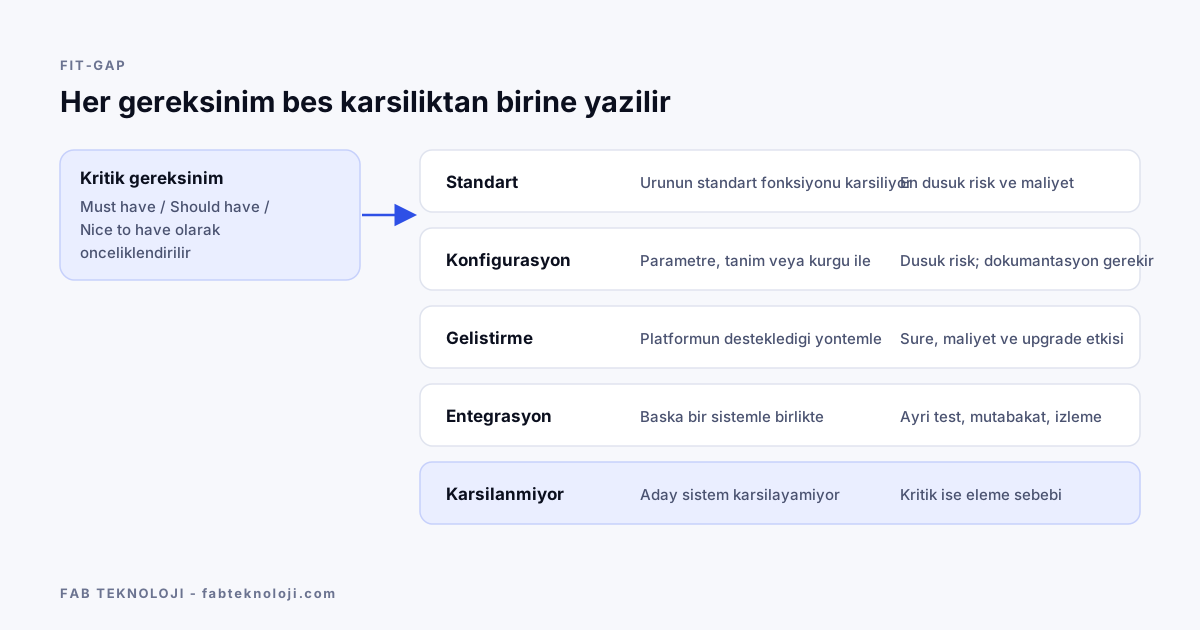
We analyse current processes department by department and separate what is met by standard functionality, what needs configuration, what needs development and what is solved by integration.
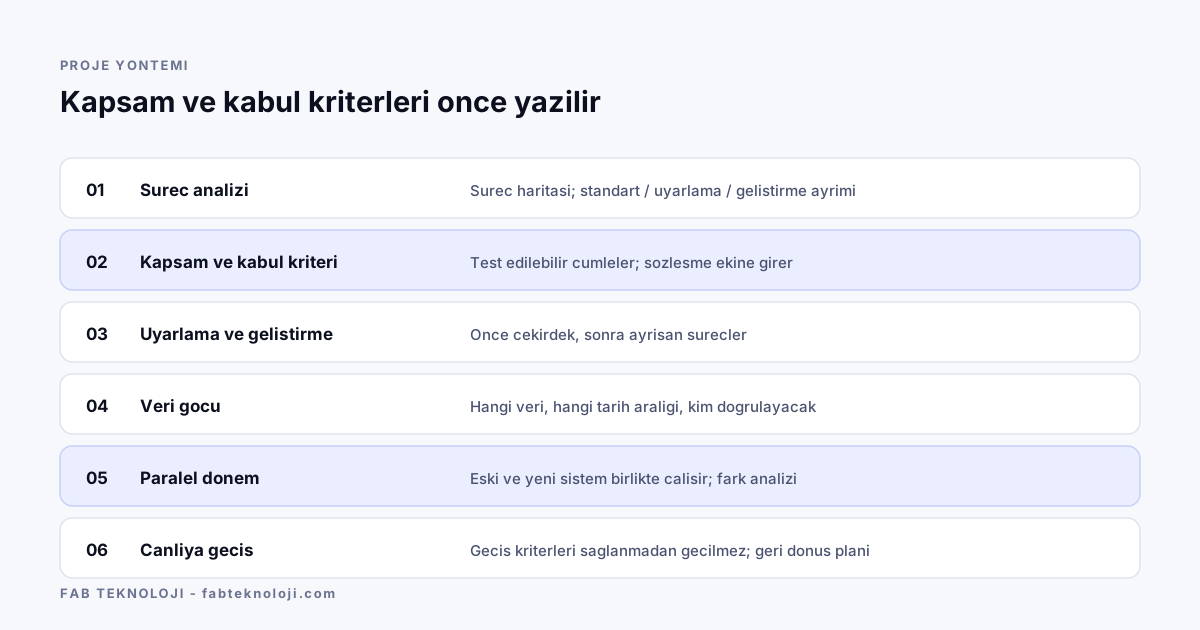
The output is not just a presentation: it is a document that can support project scope and acceptance criteria, and can enter a contract annex.
We do not compare ERP alternatives through demo screens alone. We classify critical business processes and technical requirements by importance, then assess how each candidate meets them through standard functionality, configuration, development or integration.
The headings weighed together:
| Assessment area | What is examined |
|---|---|
| Functional fit | How much of the critical processes standard scope covers |
| Manufacturing depth | Whether the product structure, operations, planning and costing model suit the business |
| Finance | Accounting, cost accounting, period close, statutory compliance |
| Integration capability | API, service, file and data access methods; the licensing status of that access |
| Data model | Master data structure, multi-unit handling, traceability, historical depth |
| Reporting | Standard reports, self-service reporting, opening data to a warehouse |
| Scalability | Growth in users, transaction volume, companies and locations |
| Security and authorisation | Role model, record-level rights, audit trail |
| Deployment model | Cloud, on-premise or hybrid; tolerance to connectivity loss |
| Licensing and TCO | Licence model, annual increases, five-year total |
| Development need | How many items fall outside standard, and by which method |
| Upgrade sustainability | How configurations are preserved through version upgrades |
| Partner and ecosystem | Consultant availability, documentation, community |
| Project risk | Scope uncertainty, data quality, team capacity |
The aim is not to find "the ERP with the highest score" but the structure that can meet the critical processes sustainably, at acceptable cost and risk.
We do not accept a single ERP brand as right for every business. Across the CANIAS and Ainos ERP ecosystems we carry out process configuration, integration, reporting, workflow, data transformation and development work according to what the project needs. We set out the scope for each ecosystem on its own page: CANIAS ERP consulting and AinosERP consulting.
Whatever the ecosystem, the same discipline applies: every configuration outside the standard is documented and its upgrade impact recorded. Configuration debt is one of the most common reasons an upgrade path locks up years later.
Which option is more defensible under which conditions is compared in alternatives in the ERP ecosystem.
In manufacturing projects the goal is not merely to raise work orders; planned production and actual consumption and operation data must be traceable on the same model.
Depending on the manufacturing type we model bills of material and recipes, routings and operations, work centre or resource structures, material consumption, labour and machine times, scrap and rework, subcontracted operations, lot and serial traceability, capacity, MRP, quality and production costing as far as they are needed. Not every business needs all of them; alternative routings or subcontracting are only built when they are genuinely used.
We impose no single costing method. Standard cost, actual cost, activity, machine and labour costs and the overhead allocation approach are designed together according to the accounting and manufacturing model. Details in the ERP guide for manufacturers.
Migration scope is not set by asking "how many years of data will move?" We treat the data in three categories:
Reconstructing historical data in the new system is possible in some cases, but the quality and gaps of the source data can limit accuracy. So for every data set the decision — move, archive, transform or keep for reporting only — is taken at the start, with the validation method written down.
In most businesses the ERP does not work alone. Data may need to flow between the ERP and banks, e-invoicing and e-dispatch, a B2B dealer portal, retail POS, WMS, e-commerce and marketplace channels, CRM, field sales, time and attendance, MES, production machines, weighbridges and third-party services.
In integration design we focus not only on establishing the connection but on record ownership, error handling, making sure retried requests never create duplicates, reconciliation, authorisation, logging, retry policy and operational observability. The method is on the API integration page and in the bank integration guide.
In multi-company structures, all companies using the same ERP does not by itself amount to consolidation. Depending on need, the project weighs a shared or separate chart of accounts, shared master data management, intercompany sales and purchasing, balances, intragroup transactions, reporting currency, elimination requirements, management reporting and financial consolidation.
In some structures the ERP's own functionality may not be sufficient for consolidation or management reporting; where that is the case we say at the start that an additional reporting layer may be required.
Not getting the expected return from an ERP does not always mean the product is inadequate. The cause is sometimes incorrect or incomplete process design, poor master data, unnecessary manual work, the reporting structure, integration gaps, performance problems, wrong authorisation or user adoption.
So before any decision on a new ERP we assess the current system technically and functionally. If the existing investment can be developed, we recommend that openly.
We do not put AI in place of verifiable business rules in the auditable finance, stock and cost records of an ERP. In suitable scenarios we do use it in a controlled way: document classification, parsing bank statement descriptions, demand forecasting, anomaly detection, natural-language reporting, management assistance and decision support.
Where an AI-produced result will turn into a financial or operational record, a validation and authorisation mechanism is designed separately: which threshold allows automatic processing, who approves it and how the result can be reversed are defined up front.
Licence cost is only one line of the total. Depending on project structure these lines can arise: licence or subscription, infrastructure or cloud, analysis, consulting, configuration, development, integration, data cleansing, data migration, testing, training, internal project team time, go-live, hypercare, maintenance and support, version upgrades and third-party licences. Where a parallel run is required, it is budgeted as its own line.
The weight of each line differs by project: in some projects the licence is a major item, while in projects with heavy configuration, data transformation or integration, implementation and internal effort can reach a similar or higher share of the total.
The line-by-line calculation is in how to calculate ERP cost, and the ERP investment and TCO pre-assessment tool produces a complexity picture and line list for your own scope.
We start with the reality of your processes and data, not with a product comparison.
We do not leave the roadmap from process analysis as a report. ERP configuration, development, integration, data migration and surrounding applications can be delivered under the same project umbrella, so analysis and implementation do not become two projects blaming each other.
Where a B2B portal, POS, bank integration, mobile app, WMS or a business-specific application is needed, we can build the architecture around the ERP as well. For us these are not work that falls outside an ERP project.
We do not treat the ERP as a finance and accounting application only; the manufacturing model, data capture and integration architecture sit at the centre of the project.
If a new ERP is not needed, improving the current system is a legitimate project option, and we say so even at the cost of losing the project.
Documentation, key user training, integration documents, change records, data ownership and the role model make a project transferable. We recommend that data ownership, development scope, access rights, documentation and handover conditions be defined explicitly at the contract stage.
Food and beverage, plastics, metal and machinery, packaging, printing, textiles, furniture, multi-store retail, healthcare and banking and finance. Each sector expects different critical capabilities from an ERP; the industry pages set them out item by item.
The full consultancy assessment is in how to choose an ERP consultancy.
We are not tied to a single ERP product. We run consulting, development, integration and transformation projects across the CANIAS and Ainos ERP ecosystems. Project scope and method are determined by the existing system and the needs of the business.
Yes. ERP consulting does not only mean implementing a new ERP. We also carry out process analysis, integration, development, reporting, data model and performance improvement work on the ERP you already run.
Not on a single problem. We weigh functional fit, technical sustainability, integration capability, user needs, development load, total cost of ownership and growth targets together.
Duration depends on the number of companies, users, module scope, manufacturing complexity, integrations, data migration and custom development. A sound estimate therefore follows process and scope analysis. When asking for a duration commitment, make sure scope is fixed too.
Not always. Master data, open transactions and historical data should be assessed separately. For some historical data, keeping it in an archive or reporting environment is a better answer than moving it into the new ERP.
No. The cut-over method is determined by project risk. A parallel run, a pilot, a phased rollout or a controlled cut-over may each be appropriate.
No. In processes that create genuine value, custom development may be necessary. What matters is that developments are documented, their upgrade impact is known, and they are built sustainably with the methods the platform supports.
There is not one. Functional fit, technical architecture, integration, total cost, the implementation ecosystem and sustainability must be weighed together.
Through a full backup before cut-over, validation of the migration against control totals, no go-live until acceptance criteria are met, and a written rollback plan. Depending on risk, a pilot or phased rollout can be part of that control.
We train by role, so each role learns only its own screens. We also develop key users inside the organisation who can carry the system, so you are not dependent on consultancy for every small change afterwards.
Let us look at your current system, the bottlenecks and your targets together. In the first call, before talking products, we clarify which problem needs solving.
Book an ERP needs analysis → ERP investment and TCO pre-assessment tool ↗
Technical discovery call
Leave your details and pick a day that suits you; we will come back to confirm. On the call we listen to your current system, the bottleneck and your goal. There is no charge for the first call.
Your request has been received.