
SAP Alternatives: Which One Makes Sense, and When
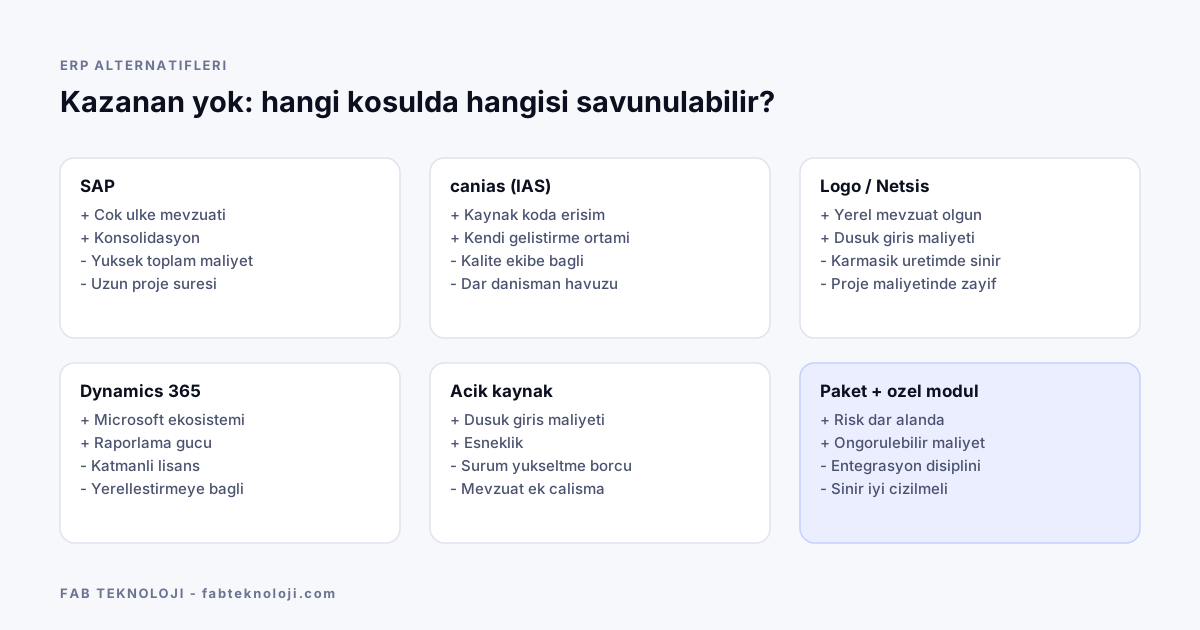
Short answer: whether SAP has an alternative depends on why you are considering SAP. If it is for multi-country statutory coverage and deep process standards, genuine alternatives are few. If you simply want "an enterprise ERP", alternatives are many and most cost less.
We declare no winner here. The aim is to show which option is more defensible under which conditions.
First: is SAP really overkill?
There are clear cases where SAP is strong:
- Multi-country operations. Having several countries' accounting and tax rules included as standard is a serious advantage.
- Multi-entity consolidation. Intercompany movements, eliminations and consolidated reporting are mature.
- Mandatory audit and process standards. When large customers or investors demand process standardisation and audit trails.
- Industry depth. In some process industries the standard scope is genuinely broad.
If none of these apply to you, the burden SAP brings — project duration, consultancy cost, specialist dependence — may not pay for itself.
The alternatives and their honest positions
canias (IAS)
Strength: source access and its own development environment (TROIA). For manufacturers with non-standard processes this means configuration can happen inside the product, reducing the need to write and integrate a separate application. Platform independence and multi-company management are standard.
Weakness: configuration quality depends heavily on the implementing team. Source access, used badly, produces configuration debt that makes upgrades hard. The consultant pool is narrower than for global products, so team turnover is a risk.
When it makes sense: mid-sized and large manufacturers whose processes do not fit standard packages.
Logo / Netsis
Strength: mature on local statutory and e-document requirements. A wide partner network, easily found users and low entry cost. Fast to deploy in small and mid-sized companies.
Weakness: limits arrive earlier in complex manufacturing (multi-level BOMs, alternative routings, project costing) and integration-heavy scenarios. High volumes may require performance tuning.
When it makes sense: companies with standard manufacturing or trading processes that want a fast, predictable move to ERP.
Microsoft Dynamics 365
Strength: natural integration with the Microsoft stack (Power BI, Office, Azure, Power Platform). Strong reporting and low-code extension. Mature cloud operations.
Weakness: layered licensing where total cost can grow quickly. For Turkish statutory requirements, the localisation pack and partner quality become decisive.
When it makes sense: organisations already inside the Microsoft ecosystem with an emphasis on reporting and analytics.
Open source (Odoo and similar)
Strength: low entry cost, modular structure, a large community and fast prototyping.
Weakness: configuration debt accumulates markedly at version upgrades. Turkish statutory requirements need extra work, and sustaining that work depends on the partner.
When it makes sense: growing companies whose processes are not yet settled, or those with a strong in-house development team.
Packaged ERP plus custom modules
Strength: the core (accounting, stock, accounts) stays packaged and only the diverging process is written. Risk is confined to a narrow area and cost becomes predictable.
Weakness: it demands discipline about integration and data ownership. If the boundary is drawn badly, "which system is right?" arguments begin.
When it makes sense: companies whose core works but whose one or two processes do not fit the package. This is the approach we most often recommend — but it is the wrong answer when the core itself is unreliable, and we say so plainly.
Comparison summary
| Criterion | SAP | canias | Logo/Netsis | Dynamics 365 | Open source |
| --- | --- | --- | --- | --- | --- |
| Entry cost | High | Medium-high | Low | Medium-high | Low |
| Configuration flexibility | Medium (governed) | High (source access) | Medium | Medium-high | High |
| Local statutory fit | Good (with localisation) | Good | Very good | Good (with pack) | Extra work needed |
| Multi-country / consolidation | Very good | Good | Limited | Good | Limited |
| Consultant availability | Wide | Narrow | Wide | Wide | Variable |
| Upgrade risk | Low-medium | Depends on configuration | Low | Low-medium | High |
This table is not a ranking. Use the matrix method in the [ERP selection guide](/en/blog/erp-selection-guide) to decide which row is critical for you.
The three most skipped items in a migration decision
1. The cost of data migration. Unless you define how much of the old data moves, project duration cannot be estimated. Opening balances only, three years of movements, or the full history? Their costs differ enormously.
2. The licensing status of API access. If you need integrations, ask in writing before signing whether data access is chargeable.
3. Whether configurations survive version upgrades. This question is not asked in demos; it surfaces three years later.
Frequently asked questions
Does it make sense to move away from SAP?
If your current SAP installation meets your needs, no; migration usually costs more than it saves. Migration typically comes up when SAP use has narrowed to a few modules and maintenance cost is out of proportion to the scope actually used.
Is using a local ERP a disadvantage in Turkey?
No. On local statutory and e-document requirements, local products usually adapt faster. The disadvantage can appear when you move to multi-country operations.
Can two ERPs run side by side?
They can, but it is expensive. In a group, different companies may run different ERPs, with consolidation built as a separate layer. Two ERPs inside one company produce data ownership disputes.
How much time should we spend before deciding?
Three to six weeks for process analysis and the selection matrix, four to eight for candidate evaluation. Shortening this means deferring scope until after signature.